

FSA Management for Progressive Employers: A Complete Guide
Employee benefits are no longer just a line item on a budget sheet. In 2026, they are a competitive differentiator. For progressive employers, Flexible Spending Accounts (FSAs) represent an opportunity to provide meaningful financial value to their workforce while reducing their own administrative burden. But managing FSA benefits effectively requires more than just offering the account — it requires modern tools, clear communication, and a strategy that minimizes forfeitures while maximizing employee satisfaction.
This guide covers everything progressive employers need to know about FSA management: why it matters, what hidden costs come with outdated administration, how modern technology is transforming the space, and what the future looks like with AI-powered solutions like daylii.

Why FSA Management Matters for Employers
Employer-sponsored FSAs remain one of the most popular pre-tax benefit offerings in the United States. According to recent benefits data, millions of employees participate in health care and dependent care FSAs through their employers, contributing pre-tax dollars that reduce their taxable income while covering qualified medical expenses.
But offering an FSA is only the first step. Effective FSA management means ensuring employees understand their accounts, use their funds wisely before deadlines, and feel supported throughout the benefits lifecycle. When employers get this right, they see higher employee satisfaction, lower turnover, and better utilization of benefits dollars.
For employers evaluating employer FSA solutions, the question is no longer whether to offer an FSA, but how to manage it efficiently in a landscape of rising health costs and increasing employee expectations for digital-first benefits experiences.
Internal link: Learn how modern benefits platforms improve employee engagement in our guide to FSA employee benefits.
The True Cost of Outdated FSA Administration
Many employers still rely on manual processes or legacy third-party administrators (TPAs) to manage their FSA programs. The hidden costs of this approach are significant and affect both the employer and the employee.
Forfeitures Don’t Just Hurt Employees
Each year, billions of dollars in FSA contributions go unclaimed. While the common narrative focuses on employee losses, the reality is that forfeitures impact employers too. Employees who lose money at the end of the plan year become disillusioned with the benefit, making them less likely to participate in future years. Lower participation rates weaken the overall value of offering the benefit and reduce the pool of pre-tax dollars flowing through the plan.
Furthermore, employees who feel burned by forfeitures may take their frustrations to employer review sites, affecting talent acquisition and employer branding in a tight labor market.
Administrative Burden on HR Teams
Manual FSA administration creates a significant drag on HR and benefits teams. Tasks like claims processing, receipt verification, eligibility inquiries, and balance tracking consume hours that could be spent on strategic initiatives. For small to mid-sized HR teams in particular, the administrative overhead of managing FSA benefits can outweigh the perceived value of offering the program.
This is where progressive employers are rethinking their approach. Instead of accepting administrative friction as the cost of doing business, they are looking for FSA administration solutions that automate the heavy lifting.
Internal link: See how modern employee benefits self-service platforms reduce HR workload.
What Does Modern FSA Management Look Like?
Modern FSA management shifts from a reactive, paper-based approach to a proactive, digital-first experience. Key characteristics include:
- Real-time balance visibility: Employees can check their FSA balance anytime, anywhere, reducing the anxiety of not knowing how much they have left to spend.
- Automated claims processing: AI-powered receipt parsing eliminates the need for manual claim submissions and reduces reimbursement times from weeks to minutes.
- Eligibility guidance at point of purchase: Integration with major retailers like Amazon, Walmart, CVS, and Instacart lets employees know before they buy whether an item is FSA-eligible.
- Proactive forfeiture prevention: Smart notifications alert employees before deadlines, suggesting eligible purchases and helping them use remaining balances.
- Seamless integration with payroll and benefits systems: APIs connect FSA data with HRIS, payroll, and benefits administration platforms, eliminating data silos.
Internal link: Explore how an integrated FSA claims management system automates the entire reimbursement lifecycle.
How Can Employers Reduce FSA Forfeitures?
Reducing forfeitures is one of the highest-leverage actions an employer can take in their FSA management strategy. Here are proven approaches:
- Employee education throughout the year: Don’t limit FSA communication to open enrollment. Quarterly reminders about eligible expenses, balance status, and upcoming deadlines keep FSAs top of mind.
- Same-day and online purchasing integrations: When employees can shop for eligible items through their everyday retailers — including Amazon, Walmart, CVS, and Instacart — they are far more likely to use their funds before they expire.
- Simplified reimbursement processes: The easier it is to get reimbursed, the more employees use their accounts. AI-powered receipt scanning and automated claims remove friction from the process.
- Grace period and carryover communication: Make sure employees understand your plan’s specific grace period or carryover provisions so they can plan their spending accordingly.
- Real-time balance and transaction alerts: Push notifications that show remaining balances and recent transactions keep employees engaged with their accounts year-round.
Traditional FSA Administration vs. AI-Powered Management
The difference between traditional FSA administration and modern, AI-powered management is stark. Here is how the two approaches compare across key dimensions:
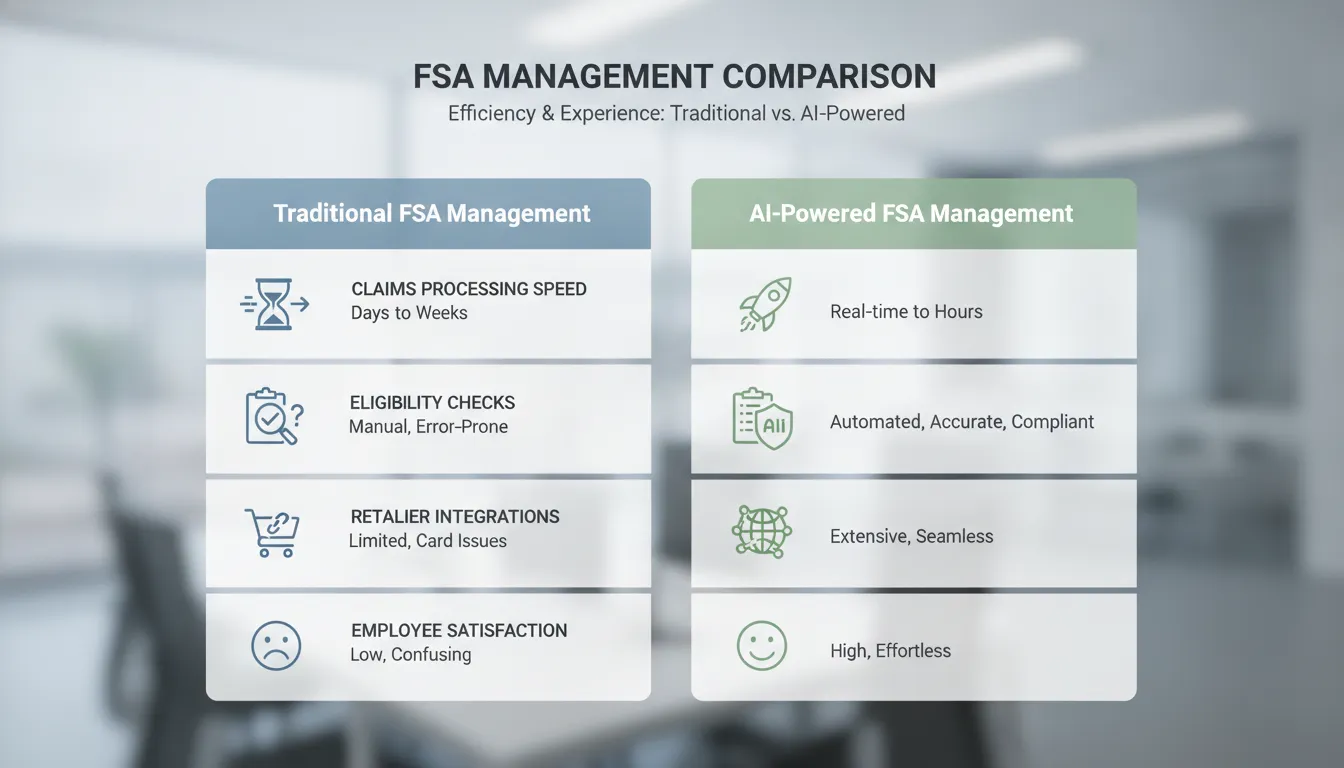
| Feature | Traditional Administration | AI-Powered Management |
|---|---|---|
| Claims Processing | Manual submission, paper receipts, 2-4 week reimbursement | AI receipt parsing, instant processing, same-day reimbursement |
| Eligibility Verification | Employee researches IRS Publication 502 manually; risk of denial | Real-time eligibility check at checkout; automated IIAS matching |
| Balance Tracking | Quarterly statements or employer portal login | Real-time mobile balance with spending insights and alerts |
| Retailer Integration | None — employee shops, pays out of pocket, submits for reimbursement | Seamless integration with Amazon, Walmart, CVS, Instacart |
| Forfeiture Prevention | Email reminder before deadline (if that) | Proactive alerts with product suggestions before deadline |
| HR Administrative Load | High — manual claims review, exception handling, phone support | Low — automated workflows, self-service employee portal |
| Employee Experience | Frustrating — paperwork, delays, uncertainty | Empowering — instant, transparent, integrated |
How Daylii Will Simplify FSA Management for Employers
Daylii is reimagining how employers and employees engage with pre-tax health benefits. While the full platform is not yet live, daylii is designed to address the core challenges of FSA management through an integrated, AI-powered approach.
DayliiMarketplace™ will connect employees with their preferred retailers — including Amazon, Walmart, CVS, and Instacart — for same-day delivery of FSA-eligible items, with real-time eligibility verification at checkout. This eliminates the guesswork and out-of-pocket burden that has traditionally made FSA spending inconvenient.
DayliiReimburse™ will use AI-driven receipt parsing to automate claims processing, turning what used to take weeks into an instant, zero-friction experience. Employees simply snap a photo of their receipt, and the system handles the rest.
DayliiDiagnosis™ will connect directly with clinical EHR systems, allowing provider-authorized spending based on ICD-10 diagnosis mapping — a level of precision that eliminates eligibility uncertainty and ensures compliance.
For employers and TPAs evaluating employer FSA solutions, daylii represents the next generation of benefits technology: consumer-grade user experience combined with enterprise-grade compliance and automation.
Internal link: Understand how modern reimbursement workflows compare in our detailed FSA reimbursement guide.
Frequently Asked Questions
Employers evaluating their FSA management options often have the same core questions. Here are answers to the most common ones.
How much does it cost an employer to offer an FSA?
The cost of offering an FSA varies depending on plan size, administrator fees, and the level of service required. Many TPAs charge per-participant fees ranging from $2 to $5 per month, plus setup and compliance costs. However, the employee retention and satisfaction benefits often outweigh these costs. Employers should evaluate total cost of ownership including administrative labor, not just TPA fees.
How do I choose an FSA administrator?
When evaluating FSA administrators, look for: technology integration capabilities (HRIS, payroll, banking APIs), employee experience quality (mobile app, real-time balance, easy claims), retailer integrations (Amazon, Walmart, CVS, Instacart), compliance expertise, and transparent pricing. Progressive employers increasingly prioritize administrator technology over traditional service models.
What are the compliance requirements for employer FSAs?
Employer FSAs must comply with IRS Section 125 cafeteria plan rules, nondiscrimination testing requirements, and specific recordkeeping obligations. Key compliance areas include: maintaining a written plan document, ensuring proper election changes, adhering to uniform coverage rules, and satisfying claims substantiation requirements under IRS Section 105. Most employers work with a TPA or benefits consultant to manage these obligations.
How can technology improve FSA management?
Technology improves FSA management across every dimension: AI-powered receipt parsing eliminates manual claims processing, real-time eligibility checks reduce declined transactions, retailer integrations make spending convenient, automated notifications prevent forfeitures, and analytics dashboards give employers visibility into plan utilization and employee behavior. The result is higher employee satisfaction, lower administrative burden, and better plan outcomes.
Take the Next Step Toward Smarter FSA Management
FSA management doesn’t have to be a source of administrative friction and employee frustration. Progressive employers are already rethinking their approach — moving from outdated, paper-based processes to modern, AI-powered solutions that reduce forfeitures, improve employee satisfaction, and free up HR teams to focus on strategic priorities.
Daylii is building the future of FSA and HSA management: a platform that combines marketplace convenience, AI-driven automation, and clinical-grade eligibility verification into a single, seamless experience. Whether you are an employer looking to modernize your benefits offering or a TPA seeking to differentiate your services, the future of FSA management is smarter, faster, and more employee-centric than ever before.
Contact daylii today to learn more about how AI-powered FSA management can transform your employee benefits experience.