
Self-employed business owners must pay both the employer and employee parts of their own payroll taxes. An HSA self-employed account provides a rare way to reduce both your self-employment tax and income tax. This tool is a key part of any modern freelancer’s financial plan.
Ready to start saving? Explore how daylii simplifies HSA management today.
An HSA self-employed plan allows freelancers and small business owners to set money aside from their gross income, greatly lowering their total tax bill. To qualify, you must be enrolled in a High Deductible Health Plan (HDHP) and have no other health coverage. These accounts offer a unique triple tax advantage where money you put in is tax-free, funds grow tax-free, and cash used for medical costs stays tax-free forever.
What Is an HSA and How Does the Triple Tax Advantage Work?
A Health Savings Account (HSA) is a tax-advantaged account paired with a High Deductible Health Plan (HDHP). It offers three tax benefits: tax-deductible contributions, tax-free growth, and tax-free withdrawals for qualified medical expenses. For self-employed individuals, contributions also reduce self-employment tax.
A Health Savings Account (HSA) is a tax-free bank account for people with a high-deductible health plan (HDHP). It helps you save for health costs and lower your tax bill. This is a top choice for those who are HSA self-employed because it gives you control over your money. To start, read this HSA Health Savings Account 101 guide to see if it fits your needs.
Ready to start saving? Join the daylii waitlist for early access.
How the Triple Tax Perk Saves You Money
The main draw of an HSA is the triple tax perk. First, any money you put in is tax-free. This lowers your taxable income right away. Second, your funds grow tax-free. You can invest the money and not pay taxes on the gains. Third, you do not pay taxes on the money you take out for health costs. This makes it a great way to save for future health needs.
The IRS says these rules apply to all qualified plans. For the self-employed, these perks are even better. Your savings can cut both your income tax and your self-employment tax. This saves you an extra 15.3% on that money. It is one of the best ways to cut your tax bill while also building a nest egg.
HSA Rules and Limits for 2026
To use an HSA, you must meet a few IRS rules. You must have an HDHP. For 2026, the minimum deductible is $1,700 for one person and $3,400 for families. You also cannot be on Medicare. There are also yearly caps on how much you can save in the account. These caps change each year to keep up with costs.
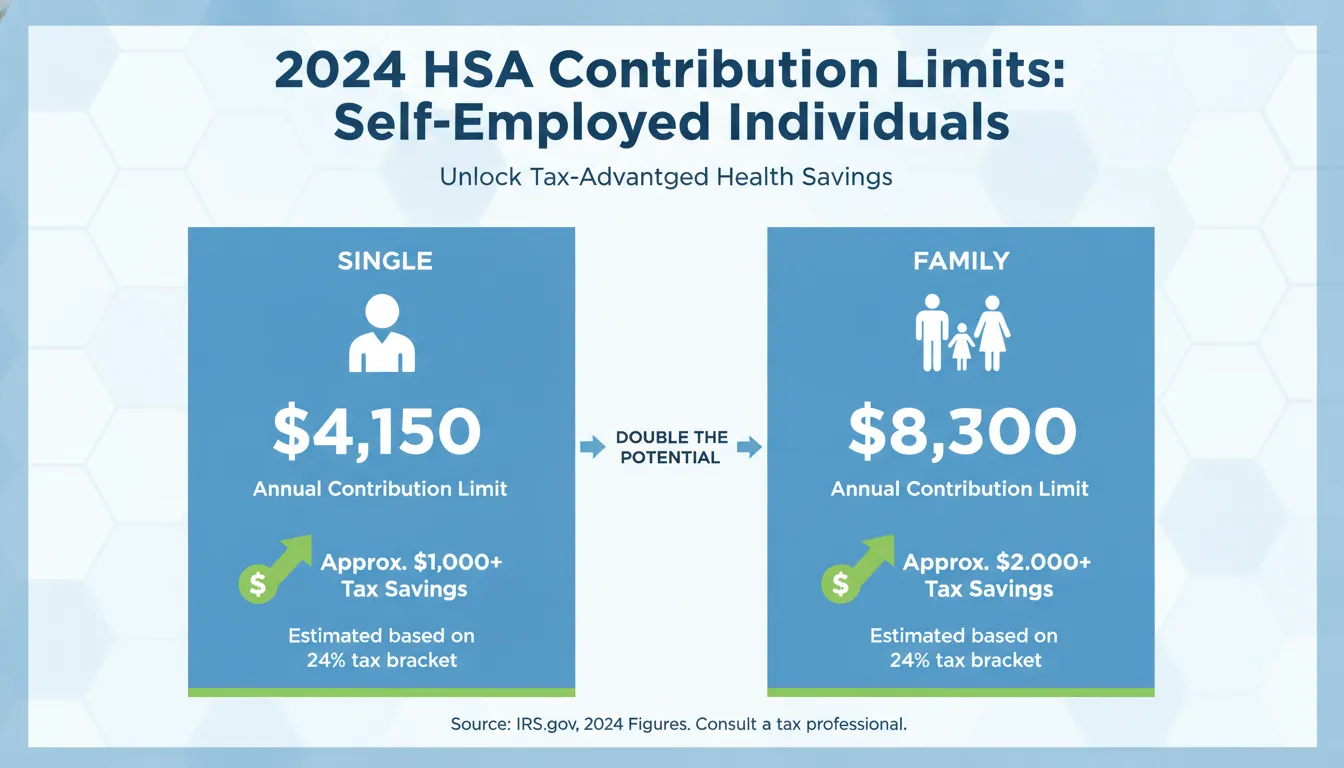
In 2026, the IRS lets one person save up to $4,400. Families can save up to $8,750. If you are 55 or older, you can add $1,000 more. Unlike an FSA, these funds do not go away at the end of the year. They stay with you year after year. This means you can keep the money for a long time. You can even use it when you retire for your health costs.
Can Self-Employed Individuals Open an HSA?
Yes, self-employed individuals including freelancers, gig workers, and small business owners can open an HSA independently. You do not need employer sponsorship. You simply need to be enrolled in a qualified HDHP and meet the IRS eligibility criteria.
Yes, you can open and use a Health Savings Account (HSA) if you work for yourself. You do not need a boss to set one up for you. This is a great choice for freelance workers and small business owners. Most of these accounts are easy to get through banks or other money firms.
An HSA Health Savings Account 101: Your Complete Guide can show you how these accounts work. This is a big change from a Flexible Spending Account (FSA). An FSA needs a company to start it. With an HSA, you are in full control.
How You Can Qualify
To start an HSA, you must first have a high-deductible health plan (HDHP). This type of plan has lower monthly costs but higher costs when you see a doctor. For 2026, the IRS rules state that your plan must have a deductible of at least $1,700 for a single person. For a family, the deductible must be at least $3,400.
You must also make sure you do not have other health insurance. This includes things like Medicare or a common FSA. Learning about FSA and HSA Eligibility: Who Qualifies is a smart first step. It helps you see if your current health plan lets you save with an HSA.
Tax Perks and Savings
The tax wins for those who work for themselves are very strong. When you put money into an HSA, you can take that amount off your taxes. If you file a Schedule C, this does two things to help your bottom line.
- Lower income tax. Every dollar you contribute reduces your taxable income for the year.
- Cut self-employment tax. HSA contributions reduce your net earnings from self-employment, saving you the 15.3% self-employment tax.
- Tax-free growth. Invested HSA funds grow without capital gains taxes.
- Tax-free withdrawals. Money used for qualified medical expenses comes out tax-free at any age.
These tax rules are a bit different for S-Corp owners or partners. Talking to a tax pro can help you get the best results for your business type. You can learn how to make the most of your savings based on how you run your firm.
In 2026, the IRS lets you put in up to $4,400 for a single plan. If you have a family plan, you can save up to $8,750. If you are 55 or older, you can add an extra $1,000 each year. These funds roll over every year so you can use them now or save them for your later years.
Managing Your Plan with daylii
At daylii, we help you manage your health spending with ease. Our DayliiPulse tool lets you track your balance in real time. It can also help you see how much you might spend in the future. This is great for keeping your business budget on track.
We also use DayliiReimburse to help you get paid back for health costs fast. It uses AI to read your receipts so you do not have to do the hard work. This takes the pain out of manual forms and long waits. Our goal is to make health care simple for everyone who works for themselves.
HSA vs Solo 401(k): How They Work Together for Maximum Tax Savings
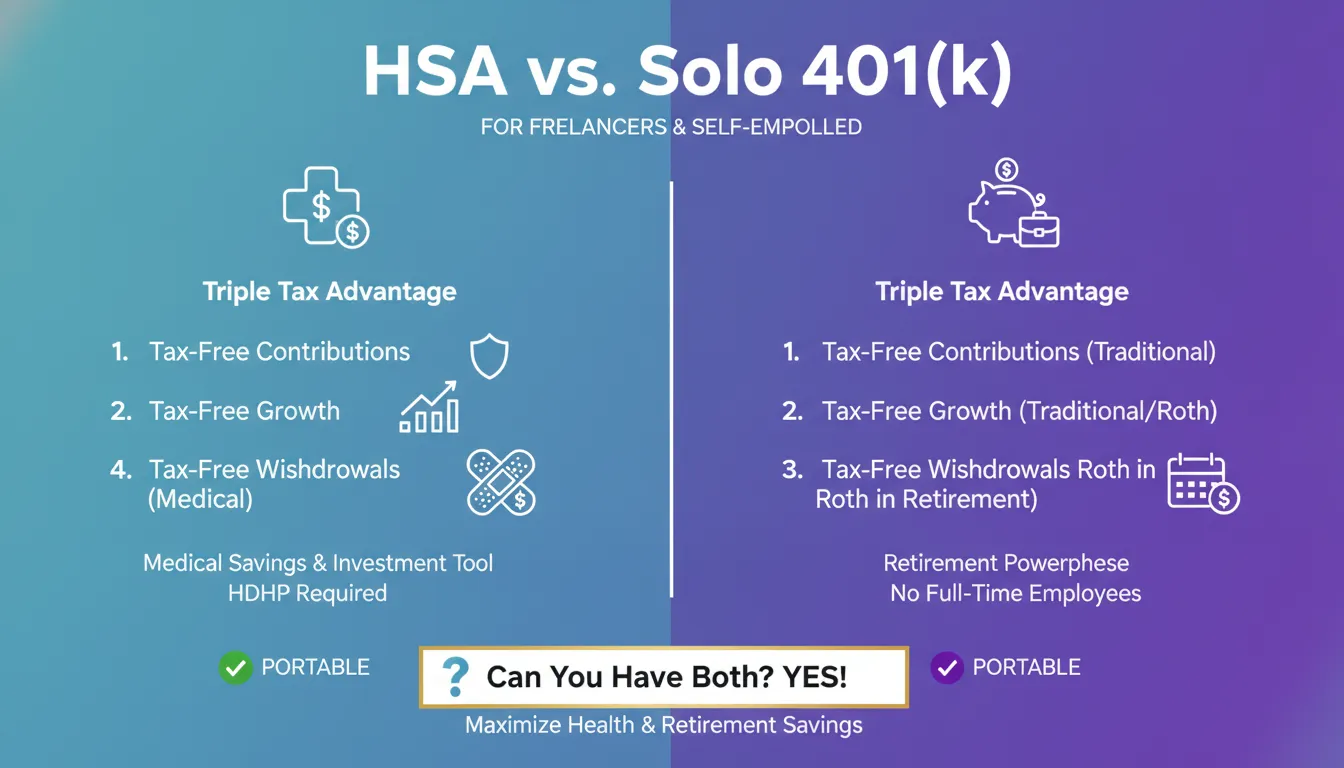
An HSA and a solo 401(k) complement each other for self-employed tax strategy. The HSA offers the triple tax advantage for healthcare costs while the solo 401(k) allows much higher retirement contribution limits. Using both maximizes your tax-deferred savings each year.
For a self employed person, taxes can be a big cost. You can lower this bill by using both an HSA and a solo 401(k). These two tools work in different ways but offer great perks when used at the same time. A solo 401(k) helps you save for the future. The HSA gives you a way to pay for health costs without being taxed. Using both tools allows you to shield more of your hard earned money from the IRS.
Key differences for the self employed
Choosing between these accounts is not always needed. You can often put money into both. The solo 401(k) lets you save much more each year. But the HSA is unique because it offers three tax wins. You get a break on the money you put in. The growth is tax free. You pay no tax when you spend it on health needs. To open one, you must have a high deductible health plan. The IRS sets strict limits on how much you can add to these plans each year.
| Feature | HSA (Self-Employed) | Solo 401(k) |
|---|---|---|
| 2026 Base Limit | $4,400 (Single) | $23,500 (Worker) |
| Tax Benefit | Triple Tax Win | Tax-Free Growth |
| Age Catch-up | $1,000 at Age 55+ | $7,500 at Age 50+ |
| Max Total | $8,750 (Family) | Up to $70,000 |
| Roll Over | Funds Stay for Life | Retirement Payout |
How to stack your tax wins
You can use these accounts to lower your total income. This helps you stay in a lower tax bracket. When you put money in an HSA, it lowers your adjusted gross income. This may help you stay under limits for other tax perks, like the Roth IRA. Self employed people also save on the 15.3% self employment tax when they use an HSA. You can learn more in our HSA health savings account 101 guide. Stacking these tools is a smart way to keep more of what you earn.
Maximize savings at every age
Let us look at a pro who is 40 years old. If they max out both plans, they could save a huge sum. They might put $4,400 into an HSA. Then they can add $23,500 as a worker in their solo 401(k). They can also add up to 25% of their net pay as the owner. This helps build a large nest egg while cutting their current tax bill to the bone. After you turn 65, you can even use HSA funds for any cost without a penalty. Using tools like daylii can help you track these funds so you never miss a chance to save.
Building a long term nest egg
Both of these plans help you grow your wealth over time. In a solo 401(k), your assets grow for your retirement years. In an HSA, the money stays with you even if you change jobs or retire. There is no rule that says you must spend the money by the end of the year. This makes the HSA a great tool for long term health costs. By using both, you ensure that you are ready for both living costs and health needs in your later years.
How to Use HSA Funds for Business-Related Health Expenses
Self-employed individuals can use HSA funds to pay for qualified medical expenses for themselves, their spouse, and tax dependents. This includes dental care, vision services, and over-the-counter medications. HSA funds cannot pay insurance premiums except in specific situations like COBRA or long-term care.
Working for yourself gives you freedom, but it also makes you the head of human resources. For self-employed people, a Health Savings Account (HSA) acts as a powerful tool to manage both personal and business-related health costs. You can use these funds to pay for many needs while lowering your tax bill.
Ready to take control of your health spending? Sign up for daylii updates and be the first to know when we launch.
Who can you cover with your HSA?
One major plus for the HSA self-employed crowd is that the funds are not just for you. You can use your account to pay for medical costs for your spouse and any tax dependents. This holds true even if they are not on your own health plan. This helps you manage family health costs from a single tax-free source.
DayliiPulse helps you track these costs for your whole family. It shows your balance in real time and helps you plan for future bills. By seeing all your spending in one place, you can make sure you always have enough in your account to cover the people who matter most.
Paying for insurance premiums
Most of the time, you cannot use HSA funds to pay for health insurance premiums. But there are a few key times when you can. If you pay for COBRA premiums after leaving a job, you can use your HSA. You can also use funds for premiums while you get state or federal unemployment help. HSA funds can also pay for qualified long-term care insurance premiums within yearly limits set by the IRS.
After you turn 65, the rules open up even more. At that age, you can use HSA funds to pay for Medicare Part B and Part D premiums. This makes the HSA a great way to save for health costs in retirement. Just be sure to avoid using funds for non-health costs before age 65, or you may face a 20% tax penalty.
Dental, vision, and everyday care
Your HSA covers much more than just doctor visits and hospital stays. Self-employed people can use funds for dental work, including cleanings and braces, and vision care like eye exams and glasses. Since the 2020 CARES Act, you can also buy over-the-counter meds without a doctor’s note. This includes common items like pain pills or allergy drugs, which helps you stay healthy while you run your business.
The IRS Publication 502 lists all the medical and dental costs you can pay for with these funds. To make this easy, dayliiMarketplace offers a simple way to check if an item is eligible at the store. This prevents your card from being declined and keeps your records clean for tax time.
How daylii Makes HSA Management Effortless for the Self-Employed
daylii is an AI-powered platform that simplifies HSA management for self-employed professionals. Its tools automate receipt capture, verify purchase eligibility in real time, track balances, and submit reimbursement claims automatically. Eliminating the manual work that causes many HSA users to leave money on the table.
Managing an HSA when you work for yourself can feel like a second job. You have to track receipts, verify what is eligible, and file claims by hand. Many people find this too hard to handle. In fact, 50% of people with an HSA do not even bother to ask for their money back because the process is so slow. Also, 64% of people avoid using their accounts because they are unsure if a purchase is allowed. This leads to missed tax savings and wasted cash for many self-employed HSA users.
DayliiPulse for balance tracking
Keeping an eye on your funds is vital for any self-employed pro. daylii makes this simple with DayliiPulse. This tool tracks your HSA balance in real time and helps you plan for future costs. It shows you how much you have spent and how much you have left for the year. This helps you plan your spending so you never run out of funds when a bill arrives. By using these facts, you can make better choices about your health budget. You will know exactly when to save and when to spend to get the most from your account.
DayliiReimburse for auto-claims
The old way of filing claims is over. You no longer need to keep piles of paper or fill out long forms on your own. DayliiReimburse uses smart tech to read your receipts for you. It checks the data and sends the claim for you right away. This saves you hours of work and ensures you get all your tax-free money back. Since the IRS requires records for all health costs, having a clear online log is a much safer bet. This tool takes the weight off your shoulders so you can focus on your work.
DayliiMarketplace for real-time checks
One of the biggest fears for a solo worker is having a health card declined. daylii stops this hassle with the DayliiMarketplace. It offers SKU-level checks at major stores like Amazon, Walmart, and CVS. You can see if an item fits FSA and HSA eligibility rules before you pay. You can even have items sent to your door the same day through Instacart. This link to over 80,000 stores ensures you get what you need fast. You can shop with ease and never have to guess if a purchase is covered by your tax-free funds.
Common HSA Mistakes Self-Employed Professionals Should Avoid
Self-employed HSA users commonly miss out on maximum tax savings by underfunding their accounts. Missing the post-tax-year contribution deadline, failing to keep proper receipts, and using funds for non-qualified expenses. Avoiding these four mistakes saves thousands in taxes and penalties.
Managing your own health savings account (HSA) gives you full control, but it also means the risk of error is higher. One wrong move could cost you thousands in tax savings or lead to a 20% penalty. To keep your money safe, you should watch out for these four common traps.
Missing out on max tax savings
Many self-employed people fail to max out their HSA contributions. When you work for yourself, an HSA is one of your best tax tools because it reduces your income tax and your self-employment tax. You can contribute up to $4,400 for an individual or $8,750 for a family in 2026, according to IRS guidelines. If you are 55 or older, you can add another $1,000 as a catch-up payment.
Forgetting the tax filing deadline
You can make HSA contributions for the prior year right up until your tax filing date, which is usually April 15. Many freelancers wait too late or forget this window exists. If you missed your goal in December, you still have time to top off your account and lower your tax bill before you file. You should check the IRS website for any deadline changes that may occur each year.
Poor record keeping for receipts
If the IRS asks for proof of your HSA spending, you must have the receipts. Many people lose their paper slips or delete digital copies. Since an HSA can act as a retirement account, you might want to pay for medical care with cash now and save the receipt for a future payout. Using daylii can help you track these costs easily and keep your records in one safe place.
Using funds for non-health costs early
If you use HSA money for things that are not medical costs before you turn 65, the cost is high. You will owe income tax on that money plus a 20% penalty. This can wipe out all the tax perks of the account. To avoid this, always check that an item is a qualified medical expense before you use your HSA card at the store.
- Not maxing out contributions. Many people only add enough to cover their known doctor visits. This misses the chance to lower your self-employment tax by 15.3% on every dollar you contribute. For those who are new to HSAs, treating it as a long-term fund is the best way to grow your net worth.
- Missing the April 15 deadline. You have until the tax due date to add funds for the previous year. This look-back period is a key tool for managing your cash flow. If you had a high-income year, making a last-minute contribution can significantly lower what you owe.
- Losing track of receipts. You need to keep proof of every medical purchase in case of an audit. Many people find this task hard to do by hand. Automating your receipt capture with tools like DayliiReimburse helps you stay ready for any tax questions.
- Withdrawing for non-medical use. Taking money out for a car repair or a vacation will trigger a 20% IRS fine if you are under 65. Treat your HSA as a health-only fund to keep your tax perks. Once you reach 65, the penalty goes away, and you can use the funds for any need.
Frequently Asked Questions
Can I have an HSA if I am covered by a spouse’s health plan?
It depends on the type of plan your spouse has. If you use your spouse’s health plan and it is not a High-Deductible Health Plan (HDHP), you cannot have your own HSA. To qualify, your only health plan must be a qualifying HDHP. But if your spouse’s plan is also an HDHP, you might be able to open your own account or share a family limit.
What is the deadline for making self-employed HSA contributions?
You usually have until the tax filing deadline to put money in for the past year. For most self-employed people, this date is April 15. Adding funds before this date lets you lower your taxes for the prior year. According to HSAforAmerica, these funds are great because they can lower both your personal income tax and your self-employment tax bills.
Do I need to keep my receipts for HSA purchases?
Yes, keeping good records is very important when you work for yourself. You do not need to send receipts to the IRS with your tax return. But you must have them ready if the IRS asks to see them. You should save all bills and receipts for medical costs you pay from your HSA. Using a digital tool like DayliiReimburse makes this process simple by saving your records automatically. This gives you peace of mind and a clean paper trail each tax season.
Can I use HSA funds for over-the-counter medications?
Yes, since the CARES Act of 2020, you can use HSA funds to buy over-the-counter medications without a prescription. This includes common items like pain relievers, cold medicine, allergy drugs, and digestive aids. You can also buy menstrual care products with your HSA funds. The DayliiMarketplace lets you check eligibility before you buy, so your card is never declined at checkout.
What happens to my HSA if I change jobs or stop working?
Your HSA stays with you no matter what. Unlike an FSA, the money does not disappear when you leave a job. You own the account and the funds in it for life. You can keep using the money for health costs even if you switch to a non-HDHP plan later. You can also transfer the account to a new HSA provider at any time. This makes the HSA one of the most flexible accounts for people who work for themselves.
Ready to Simplify Your HSA Management?
Managing an HSA while running your own business should not feel like a second job. daylii is building an AI-powered platform that automates the entire process from eligibility checks to reimbursement claims. Join the daylii waitlist today to get early access and be the first to experience a simpler way to manage your health spending.