
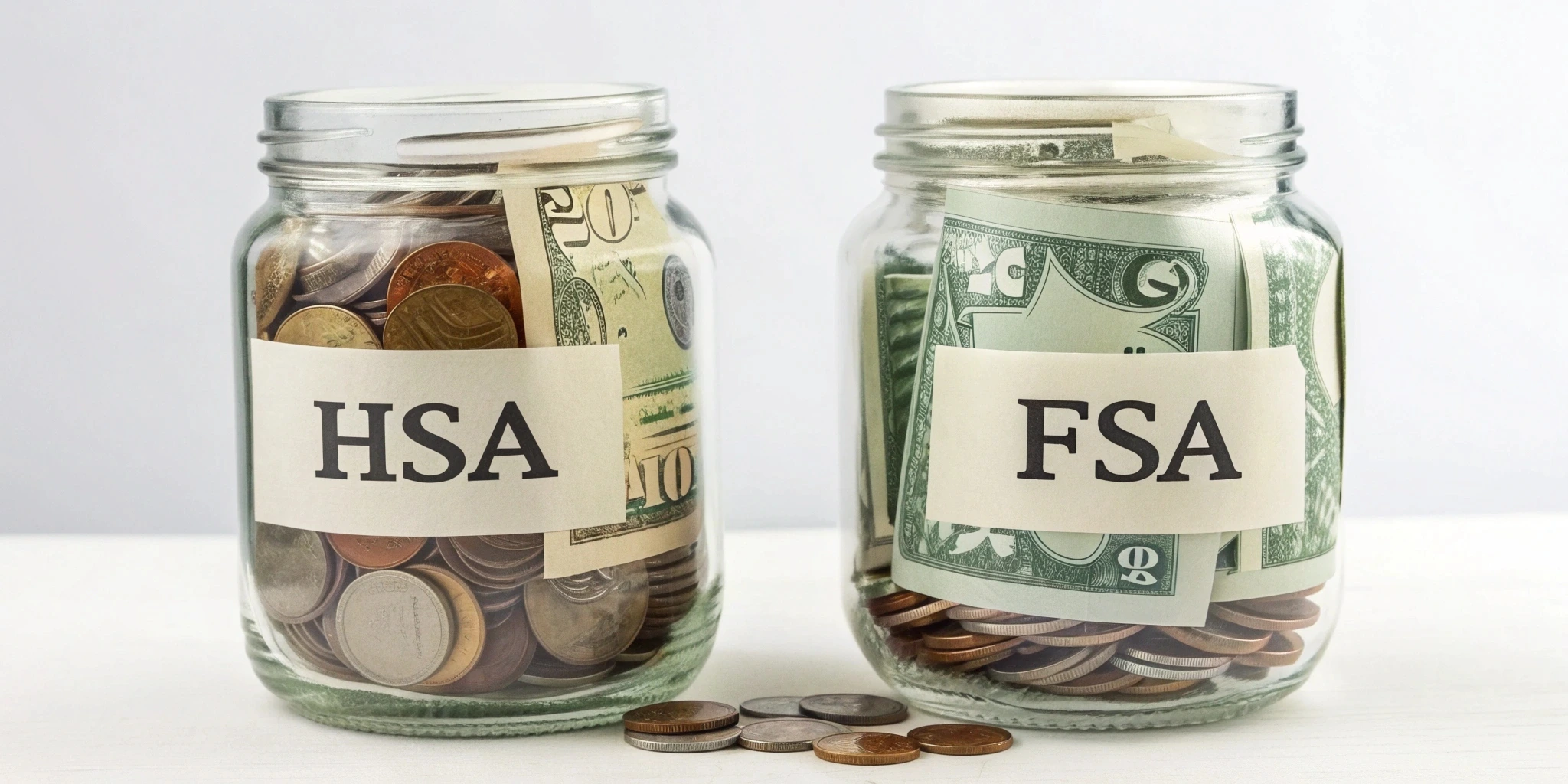
Healthcare costs keep climbing, and if you’re trying to figure out how to save money on medical expenses, you’ve probably come across two alphabet-soup accounts: HSAs and FSAs. They sound similar, they’re both about healthcare savings, and honestly, it’s easy to confuse them.
But here’s the thing—they work pretty differently, and choosing the right one (or knowing if you can use both) can genuinely affect how much money stays in your pocket. This guide breaks down everything you need to know about HSAs and FSAs so you can make a decision that actually makes sense for your situation.
What Is an HSA (Health Savings Account)?
A Health Savings Account is a tax-advantaged savings account you can use to pay for qualified medical expenses. The catch? You can only open one if you’re enrolled in a high-deductible health plan (HDHP).
Here’s how it works: You put money into the account (either through payroll deductions or on your own), and that money is yours to use for medical expenses like doctor visits, prescriptions, dental work, and more. What makes HSAs special is the triple tax advantage:
Pre-tax contributions: The money you put in reduces your taxable income.
Tax-free growth: If you invest your HSA funds, any earnings grow tax-free.
Tax-free withdrawals: When you use the money for qualified medical expenses, you don’t pay taxes on it.
The account is yours. It stays with you if you change jobs, and unused funds roll over year after year. You can even invest your HSA balance once it reaches a certain threshold, similar to a retirement account. According to the IRS, there’s no deadline to reimburse yourself for medical expenses, which means some people save receipts and let their HSA grow for decades before withdrawing.
What Is an FSA (Flexible Spending Account)?
A Flexible Spending Account is an employer-sponsored benefit that lets you set aside pre-tax dollars for healthcare expenses. Unlike an HSA, you don’t need a high-deductible health plan—you just need an employer that offers FSAs.
You decide how much you want to contribute at the beginning of the year, and that amount is deducted from your paycheck in equal installments. You can use the funds for medical expenses like copays, prescriptions, glasses, and dental care.
The big difference? FSAs have a “use-it-or-lose-it” rule. According to Healthcare.gov, if you don’t spend the money by the end of the plan year, you typically forfeit it. Some employers offer a grace period (up to 2.5 months) or allow you to carry over a small amount (up to $640 for 2025 plans, per IRS guidelines), but that’s up to your employer’s plan design.
Also important: FSAs are tied to your employer. If you leave your job, you generally lose access to the account. There’s also a dependent care FSA, which is a separate account type for childcare and elder care expenses, but that’s not the same as a healthcare FSA.
HSA vs FSA Comparison Table
| Feature | HSA | FSA |
| Ownership | You own it | Your employer owns it |
| Eligibility | Requires enrollment in an HDHP | Available with most employer health plans |
| 2025 Contribution Limit | $4,300 (individual) / $8,550 (family) | $3,300 per employee |
| Rollover Rules | Unlimited rollover | Limited or none (employer decides) |
| Portability | Stays with you if you change jobs | Ends when employment ends |
| Investment Options | Yes, once balance threshold is met | No |
| Tax Benefits | Triple tax advantage (contributions, growth, withdrawals) | Pre-tax contributions, tax-free withdrawals |
Contribution limits are from IRS Revenue Procedure 2024-25
The Key Differences Explained in Plain English
Ownership and Portability
An HSA belongs to you. Open it, fund it, and it’s yours for life—even if you switch jobs, retire, or change health plans. An FSA belongs to your employer. When you leave the company, you typically lose whatever’s left in the account.
Rollover Rules
HSA funds never expire. You can roll over your full balance from year to year, decade to decade. FSA funds operate on a use-it-or-lose-it basis, though your employer might allow a small carryover or grace period.
Investment Potential
HSAs can be invested. Once your account balance hits a certain amount (varies by provider, often around $1,000), you can invest in mutual funds or other options, letting your healthcare savings potentially grow. FSAs don’t offer investment options—they’re strictly for short-term expenses.
Eligibility Requirements
To open an HSA, you must be enrolled in a high-deductible health plan, not be claimed as a dependent on someone else’s tax return, and not be enrolled in Medicare. According to the IRS definition, an HDHP for 2025 means a plan with a minimum deductible of $1,650 for self-only coverage or $3,300 for family coverage.
FSAs don’t have health plan requirements—if your employer offers them, you can typically participate regardless of your health insurance type.
Tax Treatment
Both accounts let you contribute pre-tax dollars and withdraw tax-free for qualified medical expenses. But HSAs add a third tax benefit: your money can grow tax-free if you invest it. That makes HSAs particularly powerful for long-term savings.
Which One Should You Choose?
Consider an HSA if:
You have a high-deductible health plan and want to build long-term healthcare savings. HSAs work well if you’re relatively healthy, don’t anticipate major medical expenses in the immediate future, and want the option to invest your funds. They’re also useful if you want maximum flexibility—there’s no pressure to spend the money by year-end.
Consider an FSA if:
You have predictable healthcare expenses and want immediate tax savings. FSAs make sense if you know you’ll spend the money within the year on things like regular prescriptions, planned dental work, new glasses, or ongoing therapy. Since the full amount you elect is available at the start of the plan year, you can front-load expenses even before you’ve finished contributing through payroll deductions.
Using Both
You can’t have a general-purpose FSA and an HSA at the same time. But if you have an HSA, you can pair it with a limited-purpose FSA (LPFSA) that covers only dental and vision expenses, or a dependent care FSA for childcare costs. Check with your employer’s benefits team about what combinations they allow.
Common Myths About HSAs and FSAs
“You lose HSA money if you don’t use it”
This applies to FSAs, not HSAs. HSA funds roll over indefinitely. You could contribute this year and not touch the money for 30 years—it’s still yours.
“You can’t have both accounts”
You can’t have a healthcare FSA and HSA simultaneously, but you can have an HSA with a limited-purpose FSA for dental and vision, or with a dependent care FSA.
“FSAs aren’t worth the hassle”
If you have regular medical expenses, an FSA can save you hundreds of dollars in taxes annually. The key is accurate planning. According to the Employee Benefit Research Institute, millions of Americans successfully use FSAs each year to reduce their healthcare costs.
“HSAs are only for wealthy people”
HSAs benefit anyone who can save on healthcare costs. You can contribute as little or as much as you want (up to the annual limit), and every dollar you contribute reduces your taxable income.
Frequently Asked Questions
Can I have both an HSA and FSA at the same time?
You can’t have a general healthcare FSA and an HSA together. However, you can combine an HSA with a limited-purpose FSA (for dental and vision only) or a dependent care FSA.
Are HSA contributions tax-deductible?
Yes. HSA contributions reduce your taxable income whether they’re made through payroll deductions or directly by you. If you contribute on your own, you can deduct them on Form 8889 when filing your taxes.
What happens to my FSA when I quit my job?
You typically have until the end of the plan year (or grace period, if offered) to use remaining funds. After that, you lose access to the account. You can’t take it with you or roll it into another account. However, you may be able to continue FSA coverage through COBRA, though you’d need to pay the full cost yourself.
Can I invest HSA funds?
Yes. Most HSA providers allow you to invest your funds once your balance reaches a certain threshold. Investment options vary by provider but often include mutual funds similar to what you’d find in a 401(k). Check your HSA provider’s investment menu for specific options.
How do FSA rollover or grace period rules work?
The IRS allows employers to choose one of three options: the standard use-it-or-lose-it rule, a grace period of up to 2.5 months after the plan year ends, or a carryover of up to $640. Employers pick one—not all three. Check your plan documents or ask your HR department which option your company offers.
Tips for Maximizing Your Health Savings
For HSA users:
Set up automatic monthly contributions rather than trying to fund it all at once. Even $50 or $100 per month adds up and is easier to budget.
Keep all medical receipts, even if you don’t reimburse yourself immediately. The IRS doesn’t set a deadline for reimbursement, so you can pay out-of-pocket now and withdraw later, letting your HSA grow in the meantime.
Consider your HSA as part of your retirement strategy. After age 65, you can withdraw HSA funds for any purpose without penalty (though you’ll pay income tax on non-medical withdrawals, similar to a traditional IRA). Medical expenses remain tax-free at any age.
For FSA users:
Be conservative with your contribution amount—it’s better to contribute slightly less than to lose money. Look at your past year’s medical expenses as a baseline.
Use your FSA for predictable expenses: annual eye exams, glasses or contacts, dental cleanings, regular prescriptions, or planned procedures.
If December approaches and you have leftover funds, stock up on eligible items like sunscreen, first aid supplies, or over-the-counter medications. The FSA Store maintains a list of eligible products.
Submit receipts promptly. Don’t wait until the deadline—give yourself time to resolve any issues with claims.
Make Your Money Work for Your Health
Both HSAs and FSAs help you save money on healthcare, just in different ways. HSAs offer long-term flexibility and investment potential if you have a high-deductible health plan. FSAs provide immediate tax savings if you have predictable expenses and an employer that offers them.
The right choice depends on your health plan, your financial situation, and your healthcare needs. If you’re unsure which option fits your circumstances, your company’s HR benefits team can explain what’s available to you, and a financial advisor can help you think through the tax implications.
Understanding these accounts means understanding how to keep more of your money while taking care of your health—and that’s worth the time it takes to figure out.
Learn More About Smarter Health Savings
Choosing between an HSA and an FSA is just one step toward managing your healthcare costs more efficiently. Understanding how these accounts work—and how to make the most of them—can help you save hundreds or even thousands each year.
If you found this guide helpful and want to keep learning, you’ll find even more expert insights on how to stretch your healthcare dollars, navigate benefits with confidence, and make informed financial decisions at GoDaylii.com
References
- IRS Publication 969 – Health Savings Accounts and Other Tax-Favored Health Plans
- Healthcare.gov – Health Savings Account (HSA)
- Healthcare.gov – Flexible Spending Account (FSA)
- IRS Revenue Procedure 2024-25 – 2025 HSA Contribution Limits
- Fidelity HSA Learning Center
- Employee Benefit Research Institute
- IRS Form 8889 – Health Savings Accounts